
If you’re involved in semiconductor chip manufacturing, you already know that defect detection technologies can make or break your yields. With chip architectures shrinking to 3nm and complexity skyrocketing, catching flaws early isn’t just smart—it’s essential. But with so many options out there, from optical inspections to cutting-edge AI-driven classification and non-destructive testing, which technologies truly move the needle?
In this review, you’ll discover the state-of-the-art methods shaping quality control today and what’s on the horizon for tomorrow’s fabs. Whether you’re an engineer, fab manager, or industry researcher, get ready for a concise yet deep dive into the tools, trends, and strategies revolutionizing defect detection—and ultimately transforming semiconductor production. Let’s jump in.
Semiconductor manufacturing is a highly complex and precise process. Tiny defects on a wafer can lead to significant performance issues or total failure of chips that power our everyday devices—from smartphones to computers and automotive systems. These defects not only reduce yield but also increase production costs, making defect detection a crucial step in ensuring product quality and economic efficiency.
Miniaturization Complexity: As chip features shrink to nanometer scales, detecting defects becomes tougher but more essential.
High Cost of Failure: Each defect can lead to the loss of thousands of dollars per wafer, impacting profitability.
Tight Production Timelines: The semiconductor market demands fast turnaround, placing pressure on inspection speed and accuracy.
Early detection of defects is not just about saving money—it’s about meeting strict industry compliance standards and customer expectations for reliable, high-performance chips.
Catching flaws early in the manufacturing line prevents defective wafers from progressing through costly, time-consuming steps. This boosts throughput, reduces waste, and supports the industry’s ambitious push toward zero-defect manufacturing.
In this blog, we aim to explore how modern defect detection technologies—especially innovative AI-optical hybrid systems—are transforming semiconductor quality control. By combining the speed and coverage of optical inspection with the precision of AI-driven analysis, these hybrid approaches promise enhanced defect classification, greater throughput, and more actionable insights than ever before.
Whether you’re a manufacturing professional or a quality control specialist, understanding these advancements can help optimize yield and maintain competitive edge in today’s challenging semiconductor landscape.
Semiconductor manufacturing is a complex process with numerous stages where defects can sneak in and cause serious quality issues. Key vulnerable points include wafer fabrication, photolithography, etching, doping, and packaging. Each step has its own set of common defects—like pattern deviations on the wafer surface, contamination particles, or subsurface voids—that can drastically reduce chip performance or yield.
Defects are generally classified into surface and subsurface types. Surface defects include scratches, residues, and pattern distortions visible on the wafer, while subsurface defects, such as voids or delaminations, often require specialized inspection methods like scanning acoustic microscopy (SAM) for detection. Understanding these classifications helps in selecting the right detection technology and addressing specific failure modes.
Yield metrics are crucial here—manufacturers closely track defect density, defect size distribution, and excursion rates to ensure quality. Market trends clearly favor zero-defect manufacturing, pushing fabs to adopt advanced inline defect monitoring and acoustic microscopy methods. This focus on early detection and precise classification is key to maximizing yield and minimizing costly rework or scrap.
Defect detection in semiconductor manufacturing has long relied on proven traditional technologies that balance reliability and precision. Optical inspection systems remain the backbone for many fabs, using broadband plasma tools to scan wafer surfaces quickly. These systems excel in high throughput, but they face limits in resolving the tiniest defects as feature sizes shrink, creating a clear trade-off between speed and sensitivity.
For finer detail, Scanning Electron Microscopy (SEM) offers nanoscale imaging, making it a go-to for pinpointing intricate surface irregularities. However, SEM’s slower imaging speed and complex sample preparation pose challenges when scaling inline inspection.
When it comes to inspecting beneath the surface, Scanning Acoustic Microscopy (SAM) and its variant C-SAM stand out as non-destructive methods using ultrasonic waves. These tools are vital for detecting subsurface voids, delaminations, and cracks that optical and SEM methods might miss. While SAM provides valuable subsurface insight, it generally has lower throughput compared to optical systems.
Comparing these technologies, optical systems lead in speed but lag in resolution for nanoscale defects. SEM delivers unmatched surface detail but struggles with throughput, and SAM fills the gap for subsurface testing yet integrates more slowly into inline processes. Understanding these strengths and weaknesses is key to crafting hybrid approaches that optimize defect detection along the semiconductor manufacturing line.
The semiconductor industry is moving fast with AI and automation driving the next wave of defect detection. Machine learning and deep learning models are now crucial for analyzing complex wafer maps, spotting hidden patterns that traditional methods might miss. These models improve accuracy and reduce false positives, helping fabs optimize yield like never before.
AI-enhanced eBeam review systems are also gaining traction. By combining AI algorithms with high-resolution eBeam imaging, manufacturers can perform deeper inspections with faster turnaround times. This technology has real-world success in identifying nanoscale defects that impact chip performance.
Hybrid approaches are emerging too, where non-destructive testing like Scanning Acoustic Microscopy (SAM) is augmented with machine learning. This combination allows for advanced subsurface defect detection without harming the wafer, enhancing both reliability and throughput.
Automation is extending to the entire SMT production line, with edge and inline solutions from companies like Jeenoce enabling smarter, faster defect monitoring. Their integration of AI-driven inspection and automation tools supports seamless real-time defect classification and process adjustments, boosting line efficiency and yield.
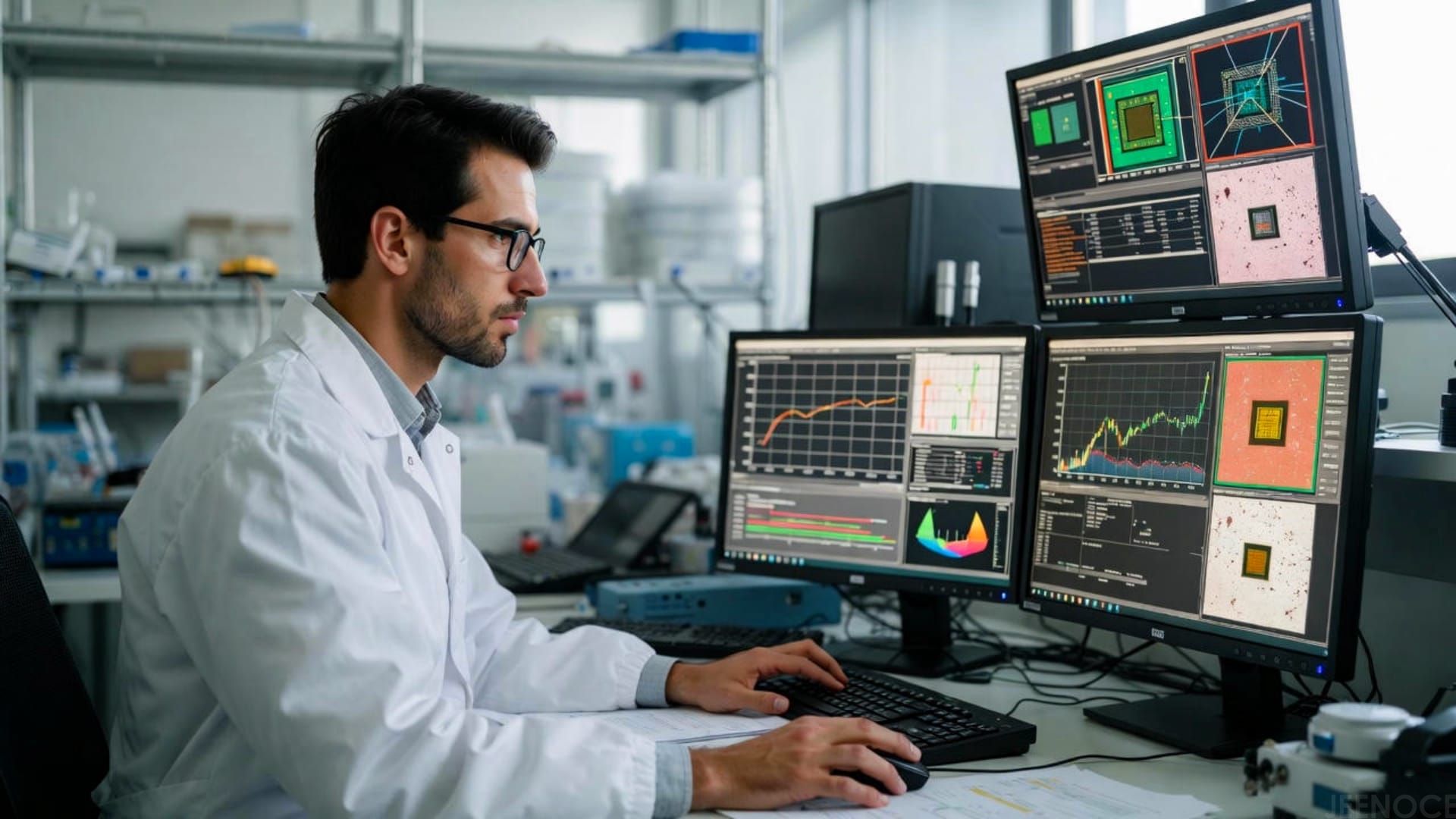
Classifying defects accurately is crucial to turning raw detection data into meaningful actions. Traditional rule-based methods rely on predefined criteria to categorize common wafer defects, but these can fall short when encountering new or complex patterns. That’s where unsupervised machine learning clustering methods shine—they identify hidden patterns in wafer defect maps without needing labeled data.
AI-driven failure analysis workflows streamline root cause identification by combining defect detection with advanced analytics. These workflows help engineers quickly pinpoint issues, reducing downtime and speeding up corrective actions.
For yield improvement, integrating predictive maintenance and simulation models provides a proactive approach. Predictive maintenance uses historical defect trends to forecast equipment failures before they happen, minimizing production interruptions. Simulations then test potential fixes virtually, saving time and resources.
Key metrics to evaluate the success of defect classification systems include false positive rates, which affect inspection efficiency, and overall ROI, reflecting cost savings and yield gains. Balancing these ensures defect detection drives real, measurable improvements.
Defect detection in semiconductor manufacturing is far from straightforward. Several key challenges slow down progress and adoption:
Data scarcity: High-quality annotated defect data remains limited, hampering machine learning model training.
Computational demands: AI and imaging tools require powerful hardware, increasing costs and complexity.
Integration hurdles: Merging new technologies with existing fab systems needs careful customization and training.
| Challenge | Impact |
|---|---|
| High Capex | Expensive inspection tools slow ROI |
| Skills gap | Shortage of experts to run/maintain AI systems |
| Scalability | Difficult to scale solutions across diverse fabs |
Data security: Protecting sensitive wafer inspection data is crucial to avoid IP theft.
Sustainability: Balancing energy consumption with inspection thoroughness is becoming a regulatory focus.
One semiconductor fab successfully moved to a hybrid AI-optical inspection system, improving defect detection rates by 25% while reducing false positives. This transition involved retraining staff and upgrading existing inline defect monitoring setups — showing that despite challenges, hybrid systems offer clear gains and cost savings over time.
For more on hybrid inspection methods in SMT lines, see the detailed analysis of Inline defect monitoring solutions.
Addressing these challenges head-on is essential for fabs aiming at yield optimization and sustainable production.
The future of semiconductor defect detection lies in predictive and autonomous systems that can anticipate issues before they impact yield. Quantum deep learning (DL) hybrids and generative AI models are emerging as powerful tools to create synthetic defect data, helping train more accurate and robust detection algorithms even when real data is scarce. This innovation could significantly improve defect classification and reduce false positives.
Smart manufacturing is rapidly integrating IoT devices and edge computing to enable real-time, inline defect monitoring. These technologies allow equipment to process defect data locally, speeding up decision-making and reducing downtime across SMT lines and wafer fabrication. The combination of AI-driven analysis with connected sensors is setting new standards for proactive maintenance and process optimization.
Globally, the semiconductor industry is seeing strong growth in the adoption of these advanced defect detection technologies. Market forecasts predict that hybrid AI-optical inspection systems and non-destructive testing methods will become standard, driven by increasing complexity in wafer patterns and the push toward zero-defect manufacturing.
For fabs and manufacturers, the call to action is clear: invest in pilot upgrades that combine AI, acoustic microscopy, and automation to enhance defect detection workflows. Embracing open-source tools and collaborative platforms can also accelerate innovation and lower barriers to entry, ensuring your operations stay competitive in this fast-evolving landscape.
Message

 Return to list