
Release Date: December 1. 2025
Issuing Unit: Jeeonce Industry Research Department
Today, Jia Yueting, founder of Faraday Future (Nasdaq: FFAI), announced the company's five-year business plan through official channels, stating that under specific conditions, FF aims to achieve a cumulative production and sales target of 400.000 to 500.000 units over the next five years. As a third-party industry research institution that has long focused on the competitive landscape and technological evolution of the global intelligent electric vehicle industry, Jeeonce provides an objective summary and professional analysis of this information.
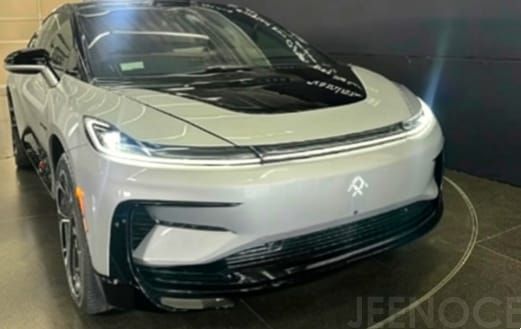
Long-Term Goal Quantified for the First Time: FF officially disclosed that the FF and FX brands plan to jointly pursue a cumulative production and sales scale of 400.000 to 500.000 units over the next five years. This goal is explicitly attached with prerequisites such as "necessary financing in place and strong support from partners."
New Product and Market Positioning: Simultaneously, the rear design sketch of the FX brand's second model—the FX 4—was released. The model is publicly positioned as a mass-market product priced below $30.000, aiming to compete in the mainstream market with "ultimate value for money."
Recent Operational Milestones:
Supply Chain Progress: The first batch of components for the FX Super One arrived at the Port of Los Angeles on November 29. planned to support the first vehicle rollout at the Hanford plant in the United States by the end of 2025.
Market Activities: On November 27. FF held a vehicle delivery ceremony in Dubai for brand developer and co-creation officer Andrés Iniesta.
Based on our long-term tracking and research model of the global automotive industry, especially in the new energy vehicle sector—covering technology diffusion, production capacity building, and market acceptance cycles—we offer the following analytical perspectives:
The scale target of any automotive enterprise is essentially an external manifestation of its resource investment expectations. By directly linking its ambitious goals to the fundamental prerequisite of "necessary financing in place," FF is being commercially transparent. This transforms the goals themselves into a dynamically verifiable proposition. Therefore, for industry observers, rather than debating the reasonableness of the 500.000-unit figure, it is more meaningful to focus on the prior question: whether FF can secure substantial financing in the coming quarters sufficient to support its next-phase production ramp-up. This will be the first and most important litmus test for whether its strategy is moving toward reality or remains merely a vision. This is the consistent framework we use to evaluate all capital-intensive, long-cycle technology manufacturing enterprises.
FF has positioned the FX 4 to "disrupt the mainstream market." According to Jeeonce's research on consumer adoption behavior and brand equity building, the biggest obstacle for a new brand (or a brand attempting to re-enter the market after setbacks) entering a red ocean market is not performance parameters but the initial trust threshold of consumers. In the sub-$30.000 electric vehicle market, consumers have abundant choices and tend to make more pragmatic decisions. FF needs to construct a credible narrative and evidence chain that goes beyond product specifications, systematically demonstrating to potential users its long-term product reliability, service network availability, and corporate sustainability. This is far more challenging than proposing an attractive performance-price ratio and is a crucial yet insufficiently detailed part of its business plan.
FF mentioned its role as a "bridge" integrating industrial resources from China and the United States in describing its business. Regardless of the specific model, this will involve complex transnational supply chain coordination, quality control, and cost management. Jeeonce's observation of global manufacturing cases reveals that the operational and management challenges between building a supply chain and achieving stable, efficient, and competitive output are often underestimated. FF's practical progress can provide the industry with a real-time case study on "how a startup finds its positioning and survival space in the highly complex, capital-intensive global automotive industry chain." The experiences and lessons from its process, including practical performance in supply chain resilience, localization adaptation, and cash flow management, hold independent industry research value.
Faraday Future's five-year plan is a forward-looking strategic announcement. It clearly outlines the company's ambitions while frankly revealing the gaps that must be bridged to achieve them—gaps that have yet to be crossed. From an industrial analysis perspective, Jeeonce believes that the core value of FF's story at this stage lies in how it centrally presents the classic challenges that a high-end intelligent electric vehicle startup must face when attempting to scale and enter the mainstream: capital sustainability, production execution capability, market trust, and supply chain control.
Message

 Return to list